
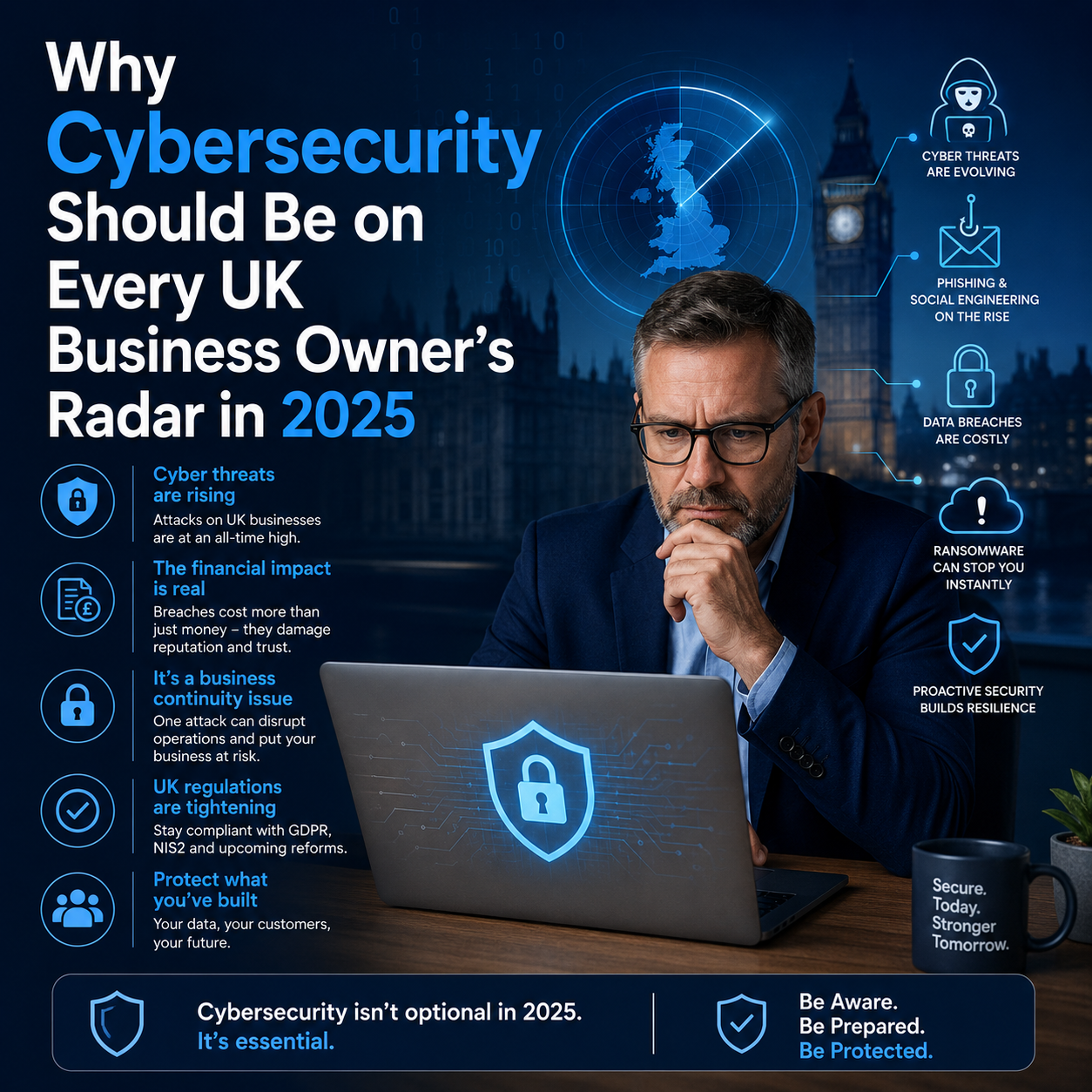
Most UK business owners think cybersecurity is something that large companies and government agencies have to worry about. The data says otherwise. Small and medium businesses are increasingly the primary targets for cybercriminals, not because they are the most lucrative, but because they are the most vulnerable. And the consequences of getting this wrong — financially, legally, and reputationally — are serious enough to shut a business down.
This article covers what the actual threat landscape looks like for UK businesses right now, what practical steps matter most, and why the common excuses for not addressing this are becoming harder to justify.
The Real Threat Landscape for UK Businesses
Phishing Remains the Most Common Entry Point
The majority of successful cyberattacks on UK businesses do not involve sophisticated hacking. They begin with a phishing email — a message that tricks an employee into clicking a link or handing over credentials. These emails have become increasingly convincing, and AI tools are making it easier for attackers to produce personalised, grammatically correct messages that bypass basic suspicion.
Once an attacker has a valid login, they can move through a business’s systems quietly for days or weeks before anyone notices. By the time the breach is discovered, the damage — data theft, ransomware deployment, financial fraud — is often already done.
Ransomware Attacks Are Targeting SMEs Directly
Ransomware gangs have shifted their model. Rather than focusing exclusively on large enterprises, many are now running high-volume campaigns against smaller businesses, knowing that SMEs are less likely to have reliable backups or incident response plans. The average ransom demand for UK SMEs has increased year on year, and many businesses end up paying simply because the alternative — extended downtime — is worse.
Supply Chain Vulnerabilities
Even if your own cybersecurity is solid, your suppliers and partners may not be. Attackers increasingly target smaller companies as a route into larger organisations. If you provide services to larger clients, your cybersecurity posture is not just your problem — it is your clients’ problem too. Several high-profile UK breaches in recent years originated through a third-party supplier with weaker controls.
What the UK Government Actually Requires
Cyber Essentials
The UK government’s Cyber Essentials scheme sets out five basic security controls that organisations should have in place: firewalls, secure configuration, access control, malware protection, and patch management. Certification is not mandatory for all businesses, but it is required for any company bidding for government contracts that involve handling sensitive data. Beyond compliance, the scheme is genuinely useful as a baseline framework.
UK GDPR Obligations
Under UK GDPR, organisations must implement appropriate technical and organisational measures to protect personal data. A data breach that results from inadequate security is not just a reputational problem — it can result in significant fines from the Information Commissioner’s Office. The ICO has shown it is willing to act, particularly where businesses have failed to apply basic security measures.
The Practical Steps That Actually Reduce Risk
Multi-Factor Authentication
Enabling multi-factor authentication on all business accounts — email, cloud storage, accounting software, banking — is the single highest-impact security measure most businesses can implement in under an hour. Even if an attacker obtains a password, they cannot access the account without the second factor. This is not optional in 2025; it is baseline.
Regular Backups That Are Actually Tested
Having backups is only useful if they work. Many businesses discover their backup system was broken when they try to restore after an incident. Backups should be automatic, stored in at least one location that is not directly connected to your main network, and tested periodically to confirm restoration works.
Staff Training That Goes Beyond a Tick-Box Exercise
Research covered by technewshype.com shows that businesses conducting regular, practical cybersecurity training — including simulated phishing exercises — see significantly fewer successful attacks compared to those relying on annual policy read-throughs alone.
The goal of training is behaviour change, not compliance. Employees who can spot a suspicious email and know exactly what to do with it are your best defence. Annual training does not achieve this. Short, frequent sessions that reinforce good habits work far better.
Patch Management — Keep Software Updated
The majority of successful exploits target vulnerabilities that have already been patched by software vendors. If your business is running software that has not been updated, you are vulnerable to attacks that should not be possible. Automated update management takes this off someone’s to-do list and removes a consistent source of risk.
When Something Goes Wrong
Have an Incident Response Plan Before You Need One
The worst time to figure out what to do during a cyberattack is while one is happening. An incident response plan does not need to be complicated, but it should cover: who is responsible for making decisions, how to contain the damage quickly, who needs to be notified (including the ICO if personal data is involved), and how to restore operations from backups.
Report to the ICO Within 72 Hours If Required
Under UK GDPR, if a personal data breach is likely to result in a risk to individuals’ rights and freedoms, you are required to notify the ICO within 72 hours of becoming aware of it. Missing this deadline does not help your position if enforcement follows. Having a clear process for assessing breaches quickly is essential.
The Cost of Doing Nothing
Many businesses avoid addressing cybersecurity because the cost feels uncertain and the benefit is invisible — you are paying to prevent something rather than to achieve something. This framing is understandable but wrong. The average cost of a cybersecurity breach for a UK SME — including downtime, recovery, and potential regulatory penalties — runs into tens of thousands of pounds. For some businesses, a single incident is enough to make recovery impossible.
The cost of multi-factor authentication is zero. The cost of keeping software updated is near-zero. The cost of training staff properly is modest. The return on these investments, measured in risk reduction, is enormous relative to the spend.
Frequently Asked Questions
Q: Does my small business really need to worry about cyberattacks?
Yes. The NCSC’s annual Cyber Security Breaches Survey consistently shows that a significant percentage of UK SMEs experience at least one attack per year. Small businesses are attractive targets because they hold valuable data — customer records, payment information, business intelligence — with fewer defences than larger organisations.
Q: What is the most important thing to do first?
Enable multi-factor authentication on every business account, starting with email. This one step prevents the majority of account-takeover attacks. After that, ensure backups are working and all software is up to date.
Q: Is Cyber Essentials certification worth it for a small business?
For most businesses, yes. The process forces a thorough review of your basic security controls, and the certification provides a credible signal to clients and partners that you take security seriously. It is also a prerequisite for government contracts involving sensitive data.
Q: What should I do if my business is hit by ransomware?
Isolate affected systems immediately, do not pay the ransom without getting professional advice first (paying does not guarantee data recovery and may make you a repeat target), notify the NCSC and the ICO if personal data is involved, and begin restoring from backups if available. Engage a cybersecurity incident response firm if the situation is beyond your internal capabilities.
Conclusion
Cybersecurity is not a technical problem — it is a business risk problem. The technical measures required to protect most UK businesses are well understood, widely available, and in many cases free or very low cost. The gap is not in the tools. It is in whether business owners treat this as genuinely important.
The businesses that will avoid major incidents over the next few years are not necessarily the ones with the biggest IT budgets. They are the ones that implemented the basics properly, trained their teams consistently, and had a clear plan for when — not if — something happened.