
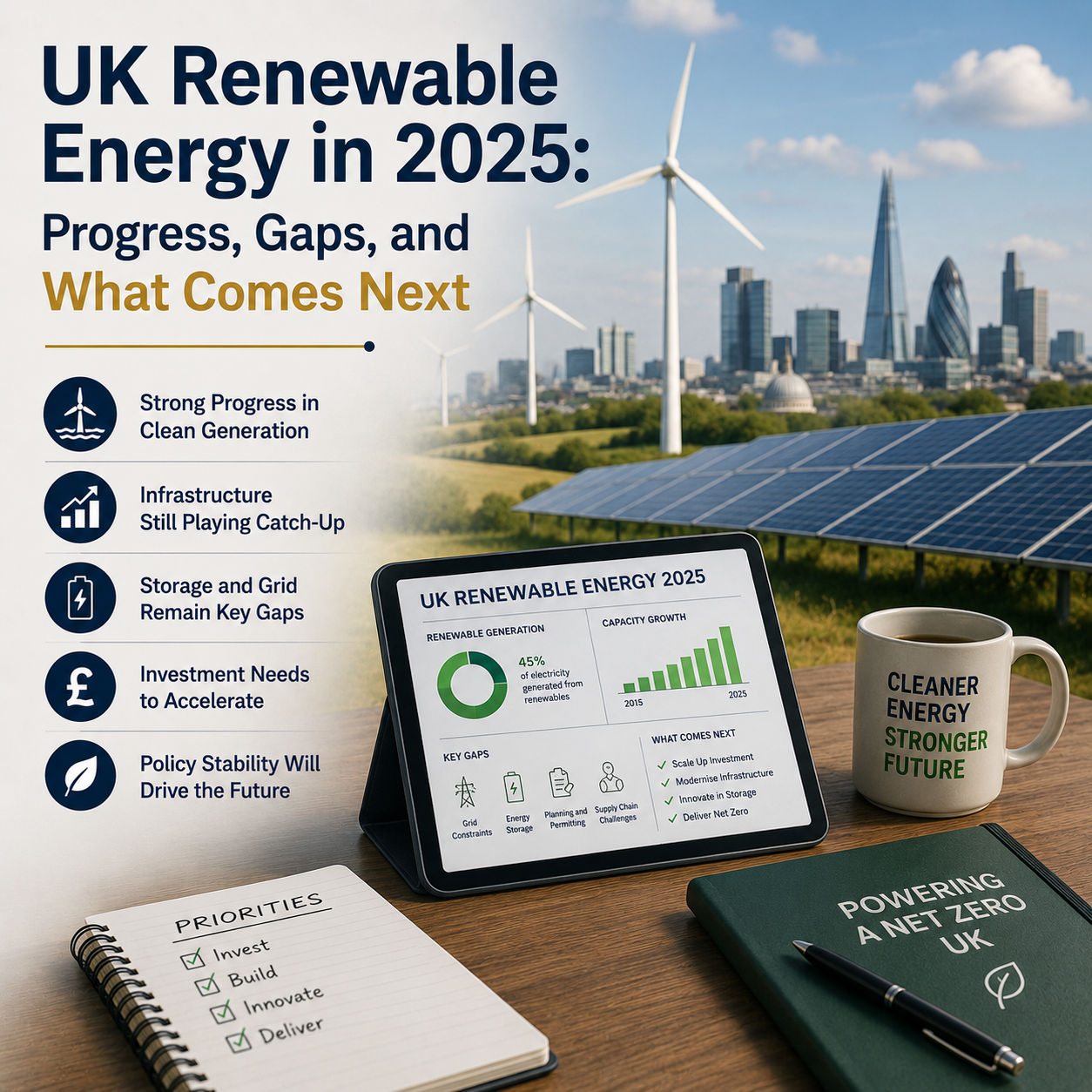
The UK has made genuine and significant progress on renewable energy over the past decade. Wind energy in particular has transformed the electricity generation mix in ways that would have seemed ambitious projections not long ago. At the same time, the path to a fully decarbonised energy system involves challenges that are not yet resolved — grid infrastructure, energy storage, hydrogen, and the politics of energy costs. A clear-eyed look at where things stand is more useful than either triumphalism or pessimism.
What the UK Has Actually Achieved
Offshore Wind: A Genuine Success Story
The UK has built one of the largest offshore wind industries in the world. Offshore wind capacity has grown dramatically over the past decade, and the UK regularly generates a substantial share of its electricity from wind — sometimes exceeding 50% of national demand on high-wind days. The cost of offshore wind electricity has fallen significantly from its early levels, making it one of the cheapest forms of new electricity generation available.
The infrastructure involved — turbines in the North Sea, Irish Sea, and around the Scottish coast — represents a major industrial achievement. Ports like Hull, Grimsby, and Teesside have developed significant supply chain capabilities around the sector.
Coal Has Effectively Been Phased Out
The UK closed its last coal-fired power station in 2024. This is a meaningful milestone. Coal was, not long ago, the backbone of UK electricity generation. Replacing it with a mix of renewables, gas, nuclear, and interconnection with European grids is a structural transformation that happened faster than many expected and with fewer of the supply security problems that critics predicted.
Solar Has Grown Substantially
UK solar capacity — both large-scale solar farms and rooftop installations — has grown significantly. Given the UK’s reputation for grey skies, the scale of solar generation regularly surprises people. Solar contributes meaningfully to the generation mix during summer months and is increasingly cost-competitive.
The Gaps That Remain
Grid Infrastructure Is the Limiting Factor
The single biggest constraint on the UK’s renewable energy expansion is not the cost of renewable generation — that problem is largely solved. It is the capacity of the electricity grid to move power from where it is generated to where it is needed. The UK’s transmission and distribution networks were built for a different energy system, with large central power stations sending electricity outward. Renewable energy, with its dispersed generation points, requires a different network architecture.
There is a queue of renewable energy projects waiting for grid connection. Some projects are waiting years. This is a planning, regulatory, and investment challenge as much as a technical one. The UK government has acknowledged the urgency and is working to accelerate grid development, but the timeline for meaningful capacity expansion is measured in years, not months.
Energy Storage at Scale
Renewable generation is intermittent — the wind does not always blow and the sun does not always shine. Managing a grid with high renewable penetration requires energy storage or flexible demand to balance supply and demand across time. Battery storage is growing rapidly and is now a meaningful part of the UK’s balancing toolkit. But the scale of storage required for a high-renewable system — particularly for multi-day or seasonal balancing — goes well beyond what batteries can currently provide economically.
Long-duration storage technologies, hydrogen-based energy storage, and pumped hydro are all being developed or expanded, but none are yet at the scale needed for full renewable system reliability without backup gas generation.
Heat Decarbonisation Has Barely Started
Electricity generation is the most visible part of the UK’s energy system and has made the most progress on decarbonisation. Heating — which accounts for a large share of UK energy use, predominantly met by natural gas — has barely started its transition. The rollout of heat pumps has been slower than government targets anticipated. The economics of heat pump installation remain challenging for many households, particularly in older, harder-to-insulate properties.
Detailed analysis of the UK’s heat decarbonisation challenge and the policy options available is covered extensively on timespost.co.uk, including cost comparisons between different heating technologies and the infrastructure requirements for a nationwide transition.
The Economics of the Energy Transition
Energy Costs for UK Households and Businesses
The energy price crisis of 2021–2023 left a lasting impact on how UK households and businesses think about energy costs. While wholesale prices have moderated, bills remain higher than pre-crisis levels, and the structure of UK energy pricing — particularly the fixed network and policy costs levied on electricity — creates ongoing tensions between affordability and decarbonisation objectives.
Decarbonising heating and transport requires electrification, which means greater demand for electricity. If electricity remains significantly more expensive than gas on a unit-cost basis, the economics of switching create barriers that policy needs to address through either subsidy or pricing reform.
Industrial Energy Costs and Competitiveness
UK industrial electricity prices are higher than in many competitor economies, which creates competitiveness challenges for energy-intensive industries. Addressing this — through a combination of grid cost reallocation, energy efficiency investment, and access to long-term renewable energy contracts — is an important part of the industrial strategy around the energy transition.
What the Next Phase Looks Like
More Offshore Wind, Including Floating Wind
Fixed-bottom offshore wind turbines are limited to relatively shallow coastal waters. Floating wind technology opens up deeper water sites, including off Scotland’s west coast and in the Atlantic, where wind resources are stronger. The UK is well-positioned to be a leader in floating wind, and investment is growing — though the technology is still maturing and costs are higher than established fixed-bottom offshore wind.
Nuclear: New Capacity Finally Moving Forward
After decades of stalled investment in new nuclear capacity, the Hinkley Point C project in Somerset is under construction and Sizewell C has received government support. Nuclear provides low-carbon, firm generation that complements variable renewables. The costs and timelines for UK nuclear projects have historically been problematic, and these projects bear watching.
Interconnectors With Europe
The UK is expanding its electricity interconnection with France, Norway, Denmark, and the Netherlands. These cables allow electricity to flow between markets, providing flexibility and allowing the UK to export surplus renewable generation and import when domestic generation is low. Interconnection is an important and underappreciated part of renewable energy system management.
Frequently Asked Questions
Q: How much of UK electricity comes from renewables?
In 2024, renewable sources — primarily wind, solar, and hydro — provided more than half of UK electricity generation for the year as a whole for the first time. The share varies significantly by time of year and weather conditions, with gas and nuclear providing the balance and backup capacity.
Q: What is the UK’s target for clean electricity?
The UK government has set a target for a fully decarbonised electricity system by 2030. Most independent analysts consider this achievable in principle but very challenging given the pace of grid expansion needed. Meeting the target would require sustained high rates of renewable deployment alongside significant grid investment.
Q: Are heat pumps a good option for UK homes?
For well-insulated homes with suitable space, heat pumps work effectively and offer lower running costs than gas boilers at current electricity prices in many scenarios. For older, poorly insulated homes, the efficiency advantages are reduced and the installation costs higher. The case for heat pumps improves as electricity-to-gas price ratios narrow, which the government’s energy market reforms aim to address.
Q: Can the UK energy grid handle a large increase in electric vehicles?
With smart charging management — where vehicles charge primarily during off-peak hours when electricity is cheaper and the grid is less stressed — the additional demand from EVs is manageable within the existing grid capacity for current EV adoption levels. As adoption increases, grid investment will be needed. Smart charging technology, which can also allow EVs to export power back to the grid, is part of the longer-term solution.
Conclusion
The UK’s energy transition is a real story of progress — one that has involved significant industrial investment, major changes to the electricity generation mix, and the development of a world-leading offshore wind industry. It has also involved genuine difficult questions about costs, grid capacity, heat decarbonisation, and the pace of change required to meet climate commitments.
The next phase — expanding the grid, scaling storage, beginning the heat transition in earnest, and bringing new nuclear capacity online — is more complex than what has been achieved so far. Progress on electricity generation demonstrated that large-scale change is achievable when policy, investment, and industrial capability align. The challenge now is extending that success to the harder parts of the energy system.
The UK is in a better position than many countries to complete this transition. Whether it does so on a timeline consistent with its climate commitments depends on decisions being made now about infrastructure investment, planning reform, and energy market design.