
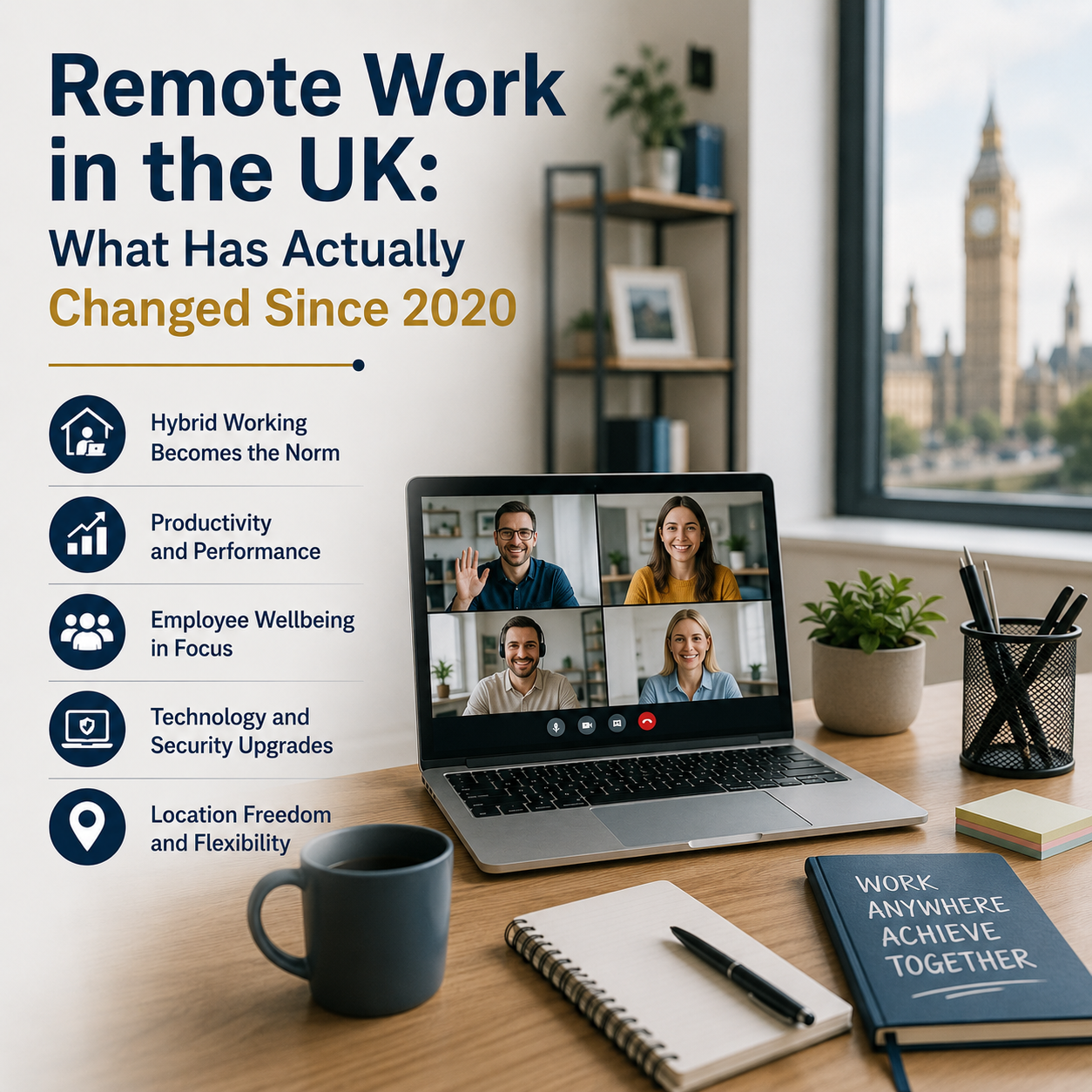
Five years on from the pandemic-forced experiment in remote working, the UK workforce has landed somewhere more nuanced than either the “office is dead” or “everyone must return” camps predicted. What has actually changed is worth examining honestly — because the picture is more complicated, and more interesting, than most coverage suggests.
Where UK Workers Actually Are Now
Hybrid Is the New Normal for Office-Compatible Roles
For jobs that can be done from a screen — which covers a substantial share of UK professional and administrative roles — hybrid working has become the default rather than the exception. The typical pattern is two to three days in the office and two to three days at home. This arrangement suits most workers and most employers, which is probably why it has proven stable rather than reverting to either extreme.
Full-time remote work is less common than the post-pandemic peak, but still significantly more prevalent than before 2020. A meaningful segment of the UK workforce — particularly in technology, finance, and professional services — works remotely full-time, often for employers based in different cities or countries.
Sector and Role Matter Enormously
The remote work conversation is dominated by professional services, technology, and knowledge work — sectors where remote work is feasible. For the large portion of the UK workforce in retail, hospitality, healthcare, manufacturing, logistics, and construction, remote work was never an option and the post-pandemic settlement looks much the same as the pre-pandemic one. It is worth keeping this in perspective when reading about the “future of work.”
What Employers Have Learned
Productivity: More Complex Than Expected
The initial data from the remote work transition suggested that productivity held up better than many managers expected. More recent evidence is more mixed. For individual, focused work — writing, analysis, coding, data processing — remote work tends to perform well. For collaborative work, mentoring, onboarding, and the informal knowledge transfer that happens in offices, the in-person environment has advantages that video calls do not fully replicate.
The most honest assessment is that the productivity impact of remote work is highly context-dependent. The same arrangement can work well for an experienced employee doing independent work and badly for a new hire who needs close guidance. Treating remote work as a uniform policy rather than a tool to be applied thoughtfully is where many businesses go wrong.
Management Has Had to Change
Managing remote or hybrid teams requires a different set of skills than managing everyone in the same room. The traditional model of management — monitoring presence and activity, holding impromptu conversations, reading the room — does not translate well to distributed teams. Effective remote management requires clearer goal-setting, more deliberate communication, and greater trust in employees to manage their own time.
Many managers adapted well. Others struggled. The organisations that invested in management development for the hybrid environment have generally had better outcomes than those that assumed good office managers would automatically be good remote managers.
What Employees Have Learned
The Commute Had a Hidden Cost
One of the clearest findings from surveys of UK workers is that the time and money saved by reducing commuting is one of the most valued aspects of hybrid and remote work. The average UK commute is around 59 minutes each way. For workers doing this five days a week, eliminating or reducing it represents a significant change in quality of life. This is a concrete, measurable benefit — not a soft preference.
Home Working Has Its Own Challenges
Working from home full-time is not universally positive. Isolation, difficulty separating work from personal life, inadequate home working setups, and reduced career visibility are all real concerns that surveys consistently identify. The workers who are most positive about remote and hybrid work tend to be those with good home working conditions, strong organisational communication, and established careers where visibility is less of a concern.
Workplace productivity research analysed by sparkjumbo.co.uk indicates that UK employees in hybrid arrangements report higher job satisfaction and lower intentions to leave compared to both fully remote and fully office-based counterparts, suggesting that flexibility — rather than any specific arrangement — is the key variable.
The Legal and Policy Landscape
The Right to Request Flexible Working
UK employees now have the right to request flexible working from day one of employment, following changes that came into effect in April 2024. Employers must consider requests reasonably and respond within two months. This does not give employees an absolute right to work remotely — employers can still decline requests for legitimate business reasons — but it shifts the default conversation and increases the expectation that flexible arrangements will be considered seriously.
Employment Law and Remote Workers
The location where work is performed can have implications for employment law, tax, and social security — particularly for employees working from overseas. UK employers with staff working remotely from other countries face potentially complex obligations, and this is an area where many organisations are still finding their way through the practical and legal implications.
What Has Changed for UK Cities and Commercial Property
Office Markets Have Adapted, Not Collapsed
The predicted collapse of the UK office market has not materialised in the way many forecast. Demand for large, traditional office space has reduced, but demand for high-quality, well-located office space — with good facilities and flexible lease terms — has held up. What has suffered is outdated, inflexible office stock in secondary locations.
City Centres Outside London Have Benefited
The shift to hybrid working has, in some respects, been good for UK cities outside London. Workers who no longer commute five days a week have more reason to use local amenities — cafes, shops, restaurants — near where they live. Some smaller towns and cities have seen increased footfall and economic activity as a result of workers spending more time locally.
Where Things Are Going
The Return-to-Office Push
Several large UK employers — following moves by major US firms — have pushed for increased office attendance in 2024 and 2025. In most cases, this has meant moving from two to three days in the office rather than demanding a return to five. Full-time return mandates are the exception and have, in some high-profile cases, resulted in increased staff turnover.
AI’s Impact on Where Work Gets Done
The growth of AI tools is having a quiet but significant effect on remote work dynamics. AI assistants that handle scheduling, summarise meetings, draft communications, and provide real-time information reduce some of the coordination friction that made distributed teams harder to manage. As these tools improve, some of the in-person advantages of office working may be partially replicated digitally.
Frequently Asked Questions
Q: Can employers in the UK force staff to return to the office full-time?
Yes, provided the change is consistent with employment contracts. However, mandating a return that conflicts with agreed flexible working arrangements or that was not specified in contracts may give rise to employment law issues. Many employers find that mandating full-time return without strong justification leads to increased staff turnover, particularly among higher-skilled workers who have more options.
Q: Is remote work actually less productive?
The evidence is mixed and context-dependent. Focused, individual work tends to be as productive or more so when done remotely. Collaborative, mentoring, and culture-building activities tend to benefit from in-person interaction. The most productive arrangements are typically those designed thoughtfully for the specific nature of the work, rather than blanket policies either way.
Q: What are the tax implications of working from home in the UK?
Employees who work from home regularly may be able to claim tax relief for additional household costs through HMRC’s working from home relief scheme. Employers can also make tax-free payments to employees to cover home working costs up to specified limits. The specifics depend on the arrangement and should be confirmed with a tax adviser for individual circumstances.
Q: How do you build a good team culture with hybrid or remote working?
Intentional effort is required that does not happen naturally in a hybrid environment. This means designating in-person time for collaboration, onboarding, and social connection; using asynchronous communication tools well; creating visibility for work done by remote employees; and ensuring managers actively include remote team members in opportunities and information flow.
Conclusion
The remote work settlement that has emerged in the UK is, on balance, a reasonable one. Hybrid working gives employees flexibility while maintaining the in-person connection that many workplace relationships and activities genuinely benefit from. It is not a perfect solution — managing distributed teams is harder, career progression for remote workers is more complex, and not everyone has a home environment suited to productive work.
But the alternative — returning to a world where virtually all office workers commute five days a week regardless of what their actual work requires — is harder to defend on the evidence. The organisations that will manage this best are those that think carefully about when in-person collaboration genuinely adds value, build that into their working model deliberately, and give employees the flexibility to be productive everywhere else.