
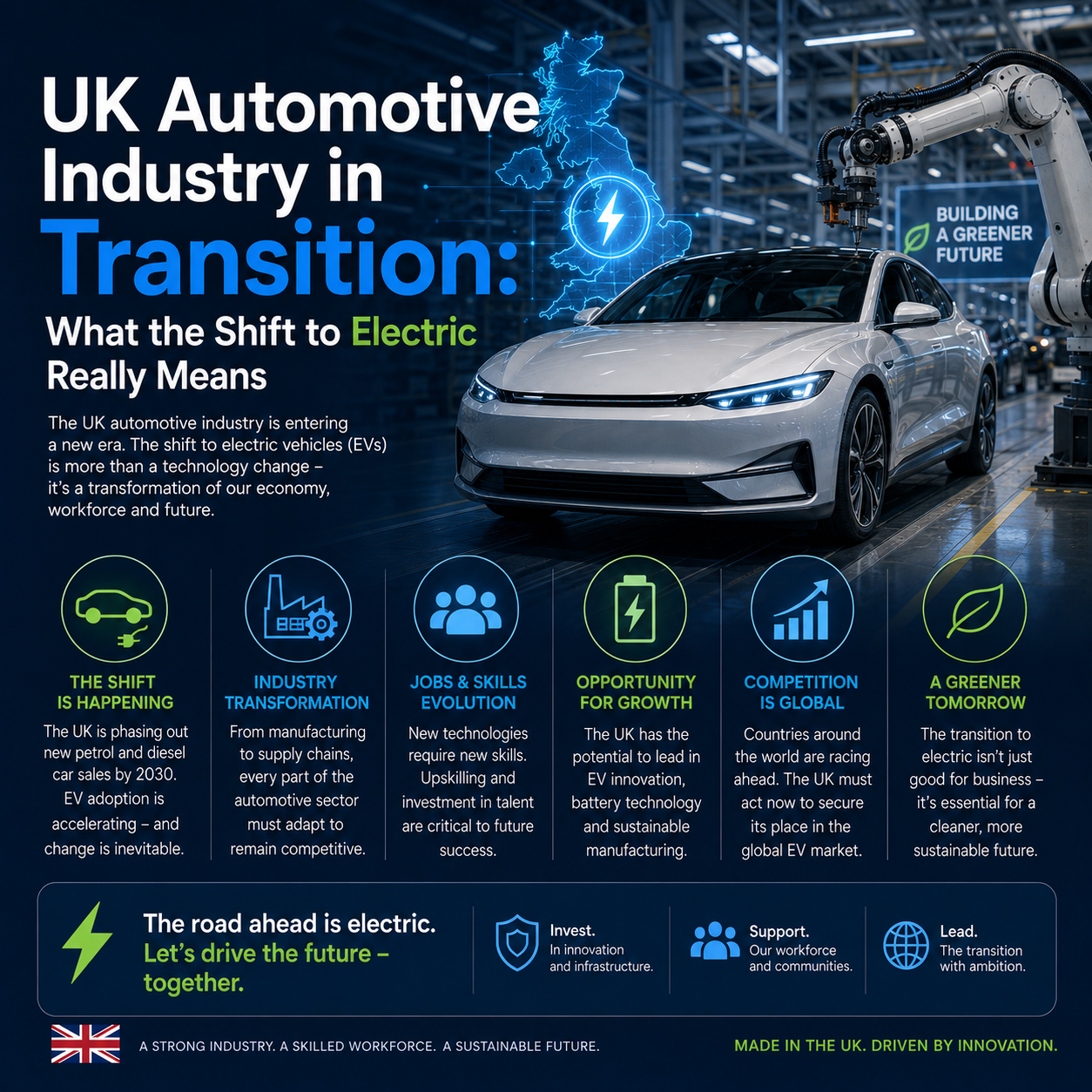
The UK automotive sector is in the middle of its most significant transformation in over a century. The shift from internal combustion engines to electric vehicles is not just a technology change — it is a supply chain overhaul, a workforce challenge, and a strategic competition between countries for the future of vehicle manufacturing. Understanding what is actually happening, rather than the simplified version that tends to dominate headlines, matters for anyone connected to this industry.
The Scale of What Is Changing
From Combustion to Electric: More Than Swapping an Engine
Electric vehicles have fewer moving parts than combustion engine cars — around 20 moving components in an EV drivetrain compared to over 2,000 in a traditional petrol or diesel powertrain. This sounds straightforward, but the implication is enormous: a huge portion of the UK’s existing automotive supply chain makes components that EVs simply do not need. Exhaust systems, fuel injectors, transmission components, alternators — all of these face declining demand as EV adoption increases.
What EVs need instead is different: battery cells and management systems, electric motors, power electronics, and software. Much of the current capability in these areas sits outside the UK, particularly in Asia and, increasingly, in continental Europe.
Battery Manufacturing Is the Central Challenge
The battery pack is the most expensive single component in an electric vehicle, typically representing 30–40% of the total vehicle cost. For UK-manufactured EVs to remain competitive — and to qualify as “UK-made” under trade agreements — there needs to be domestic battery manufacturing capacity. Without it, vehicle manufacturers face the prospect of importing batteries at cost, reducing their margins, and potentially losing trade preference under rules of origin requirements.
The UK has been slower to develop gigafactory capacity than Germany, France, or Scandinavia. Nissan’s plant at Sunderland, with its associated Envision AESC battery facility, represents the most advanced example of this integration in the UK, but the overall scale of domestic battery manufacturing remains limited relative to the ambition of automakers operating here.
Jobs: Honest Numbers, Not Reassuring Narratives
Which Roles Are at Risk
The SMMT and various research bodies have modelled different scenarios for UK automotive employment through the EV transition. The consistent finding is that roles most closely tied to combustion engine component manufacturing face the highest displacement risk. This includes skilled machining, engine assembly, and associated quality and engineering roles at suppliers.
These are not low-skill jobs. Many are well-paid, unionised positions in communities where automotive is the primary employer. The transition risk is not evenly distributed across the country.
Where New Jobs Are Expected to Come From
EV manufacturing creates demand for battery technicians, power electronics engineers, software developers embedded in vehicle systems, and charging infrastructure specialists. These are real job categories. The honest caveat is that the number of roles created is unlikely to fully offset those displaced, and the skills required are different enough that reskilling existing workers — while possible — requires serious investment and time.
Industry analysis published on totalengines.co.uk highlights that the UK needs a coordinated national skills strategy for the automotive EV transition, not just piecemeal retraining programmes, if regional employment levels in traditional automotive communities are to be maintained.
The Policy Environment
The Zero Emission Vehicle Mandate
The UK government’s Zero Emission Vehicle (ZEV) mandate requires that an increasing percentage of new cars and vans sold by each manufacturer must be zero emission each year, rising to 100% for new cars by 2035. This gives manufacturers a clear regulatory direction and is intended to create demand certainty that justifies investment in EV production capacity.
In practice, manufacturers have lobbied for, and received, some flexibility in how they meet annual targets — including the ability to purchase credits from manufacturers that have exceeded their own targets. This flexibility reduces the cliff-edge risk for those behind on EV volumes, but also slightly dilutes the mandate’s near-term pull on EV investment.
UK vs EU: The Rules of Origin Question
Under the UK-EU Trade and Cooperation Agreement, EVs must meet specified rules of origin requirements to trade tariff-free between the UK and EU. The battery component requirements have been a subject of negotiation and adjustment, as hitting the original thresholds would have disadvantaged manufacturers on both sides. This is an ongoing issue that affects investment decisions for any manufacturer selling into both markets from UK factories.
What Is Actually Happening on the Ground
Jaguar Land Rover’s Transformation
JLR is investing heavily in transitioning its manufacturing to support electric and hybrid Range Rover and Jaguar products. The company’s Solihull plant is central to this, with significant capital expenditure committed to retooling. This is one of the most watched transitions in UK automotive given JLR’s scale and its importance to the West Midlands economy.
Mini and Oxford
The MINI plant in Oxford is now producing the all-electric MINI Cooper, representing a significant commitment to the site’s long-term future. Parent company BMW’s decision to build the electric MINI in the UK — rather than China, where some production had shifted — was a deliberate investment in UK manufacturing competitiveness.
The Vauxhall Ellesmere Port Decision
Stellantis converted its Ellesmere Port facility to produce electric vans — the Vauxhall Combo Electric among others — after the site’s future was in significant doubt. This conversion was supported by UK government investment and represents a model for how combustion-era plants can be adapted rather than closed.
What Consumers Need to Know
Range and Charging: Where Things Actually Stand
The most common consumer concern about EVs — range anxiety — is becoming less relevant for most use cases. The majority of UK drivers travel well within the range of a modern EV on a daily basis, and home charging overnight resolves the inconvenience for those who have access to it. The genuine challenge remains for those without off-street parking, and for long-distance drivers who rely on public charging infrastructure that is still patchy in coverage and reliability.
Total Cost of Ownership
EVs typically have higher upfront purchase prices than equivalent combustion vehicles, but lower running costs — electricity costs less than petrol per mile, servicing requirements are reduced, and some taxes are more favourable. Over a typical ownership period, the total cost of ownership can be comparable or better for EVs, depending on mileage and energy costs. The upfront price gap is narrowing as EV volumes increase and battery costs fall.
Frequently Asked Questions
Q: Will UK car manufacturing survive the EV transition?
The plants that have secured EV production mandates from their parent companies — Sunderland, Oxford, Ellesmere Port, Solihull — have a credible path forward. The greater risk is in the supply chain, where smaller component manufacturers serving combustion engine markets have not yet found their equivalent role in the EV ecosystem.
Q: When will EVs become the majority of new car sales in the UK?
The ZEV mandate’s trajectory points toward EVs representing the majority of new car sales well before 2035. Current market share data suggests this could happen by the late 2020s if public charging infrastructure improves and upfront costs continue to fall, but consumer adoption rates remain the key variable.
Q: Does it matter where the battery in my EV is made?
From a pure performance perspective, no — battery technology from leading manufacturers is broadly comparable regardless of origin. From a supply chain resilience and trade perspective, it matters considerably to vehicle manufacturers and governments who are trying to reduce dependence on non-domestic battery supply chains.
Q: What happens to petrol and diesel mechanics as EVs become more common?
Traditional mechanical skills become less relevant for EV servicing, which is more software and electrical diagnostic work. Many garages and mechanics are actively retraining, and programmes exist to support this transition. The timeline is long enough — given the existing combustion vehicle fleet — that the change will be gradual rather than sudden.
Conclusion
The UK automotive industry’s transition to electric vehicles is not a question of if, but how well. The plants that have secured long-term EV production commitments are in a stronger position than the press coverage of the sector sometimes suggests. The supply chain and skills challenges are real, and the honest assessment is that without sustained government and industry investment in battery manufacturing capacity and workforce development, the UK risks becoming an assembler of imported components rather than a genuine centre of EV production.
For consumers, the practical picture is more straightforward: EV technology has matured significantly, the running costs are compelling, and the remaining barriers — upfront cost and charging access — are reducing year by year. The transition is happening. The question is whether the UK’s industrial base will be in good shape when it arrives.