
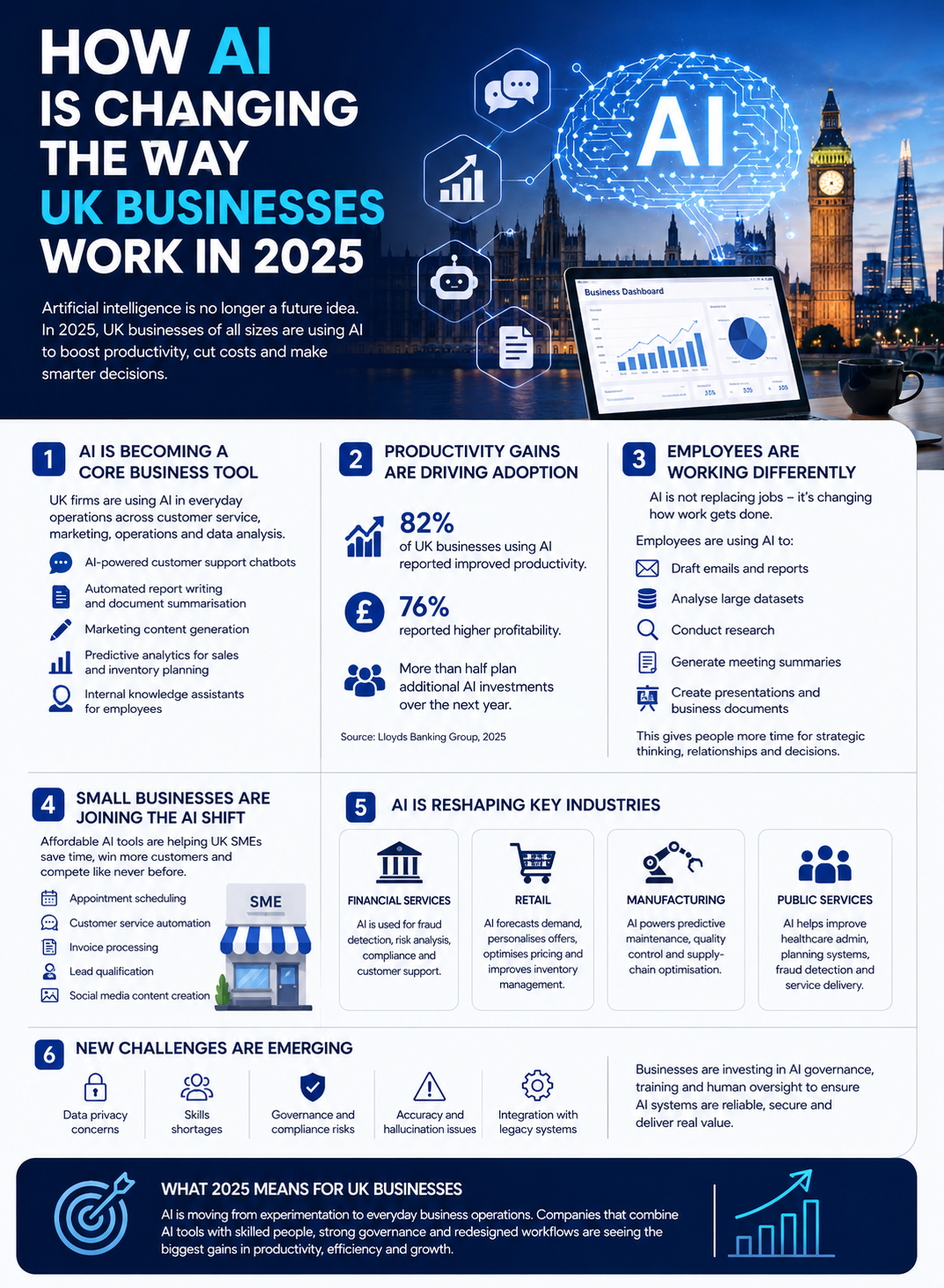
Artificial intelligence is no longer something that only big tech firms in Silicon Valley talk about. Right now, small businesses in Manchester, mid-sized firms in Birmingham, and large enterprises in London are all rethinking how they hire, operate, and grow — because of AI tools that have become genuinely affordable and accessible.
This is not hype. This is a structural shift in how work gets done. And if you run a business in the UK, understanding what is actually changing — and why it matters — is more useful than reading another list of “top AI tools to watch.”
What Has Actually Changed in the Last Two Years
The conversation around AI changed around late 2022 when large language models became available to the general public. But the real impact on UK businesses came later, in 2024 and into 2025, as companies moved from experimenting to actually embedding these tools in daily workflows.
Automation Beyond the Factory Floor
AI-driven automation used to mean robotic arms on production lines. That mental image is outdated. Today, automation is happening in accounting departments, customer service teams, HR functions, and even in content and legal work. Tasks that once required a junior employee — drafting emails, summarising reports, scheduling, basic data analysis — are now handled faster and with fewer errors by AI systems.
This does not mean mass redundancy across the board. It means job roles are shifting. The people who understand how to work alongside these tools are becoming far more valuable than those who cannot.
Customer Experience Is Getting More Personalised
AI allows businesses to personalise at a scale that was simply not possible before. A retailer can now show different product recommendations to different customers in real time. A financial services firm can tailor its communication based on each client’s behaviour patterns. This kind of personalisation used to require large data science teams. Now it can run with relatively modest investment.
The Industries Feeling It Most
Retail and E-commerce
UK retailers are using AI for demand forecasting, inventory management, and customer communication. Companies that got this right in 2024 were able to reduce overstock, cut waste, and respond faster to shifting consumer preferences — all of which have a direct impact on margins.
Financial Services
From fraud detection to credit scoring to regulatory compliance, AI has become a core part of how financial institutions manage risk. The FCA has acknowledged this shift and is working on clearer guidance for AI use in financial services, which signals that regulators are catching up to what is already happening on the ground.
Healthcare and Life Sciences
The NHS and private healthcare providers are using AI to support diagnostics, manage patient records, and reduce administrative burden. In drug development, AI is dramatically shortening the time it takes to identify promising compounds — a process that used to take years of manual research.
What This Means for Smaller UK Businesses
Here is the part that often gets overlooked in AI coverage. Most of the conversation focuses on enterprise-level transformation. But the tools available today are affordable enough for a 10-person business to use meaningfully.
Practical Entry Points for SMEs
- Using AI writing assistants to speed up email, proposal, and marketing copy drafting
- Integrating AI-powered chatbots for basic customer enquiries
- Using AI scheduling and calendar tools to reduce back-and-forth admin
- Applying AI analytics to understand which customers are most likely to churn
None of these require a dedicated data science team or a six-figure software budget. Most are available on monthly subscription plans that cost less than a single day’s wages for one employee.
The Skills Gap Is Real — and Growing
The biggest barrier for UK SMEs is not access to AI tools. It is knowing how to use them well. There is a growing gap between businesses that have invested in upskilling their teams and those that have not. This gap will widen over the next two to three years, and it will show up directly in productivity and profitability.
According to industry analysts at industryinfo.co.uk, UK businesses that actively invest in AI literacy training are outperforming their peers across key operational metrics, from customer retention to output per employee.
Concerns That Deserve a Straight Answer
Is AI Taking UK Jobs?
Some roles are being automated away. That is honest. But the data on net job creation from Super Tech City technology shifts historically shows that new categories of work emerge as old ones shrink. The question for UK workers and businesses right now is not whether AI will change the job market — it already is — but whether we are moving fast enough to adapt.
What About Data Privacy?
This is a legitimate concern, particularly under UK GDPR. Any business using AI tools that process personal data needs to ensure those tools comply with data protection obligations. Reputable providers are clear about how data is stored and processed. If a tool is not transparent about this, that is a red flag worth taking seriously.
Can You Trust AI Output?
AI tools make mistakes. They can produce plausible-sounding information that is factually wrong. The safest approach is to treat AI output as a first draft or a starting point — not as a finished, verified product. Human review is still essential, particularly in anything involving legal, medical, or financial decisions.
Where Things Are Heading
Agentic AI Systems
The next wave of AI is not just about generating text or images. It is about AI agents that can take actions — browsing the web, sending emails, filling forms, managing files — on behalf of a user. This is already in early deployment stages at some organisations and will become mainstream within the next couple of years.
AI in Supply Chain Management
UK manufacturers and logistics companies are increasingly using AI to predict disruptions, optimise routes, and manage supplier relationships. Given the supply chain volatility of recent years, this is one area where AI delivers very clear, measurable value.
Regulation Will Catch Up
The EU AI Act is already in force, and while the UK government has taken a more principles-based approach rather than a prescriptive one, sector-specific regulation is coming. Businesses that get ahead of compliance now will be in a much stronger position when formal requirements arrive.
Frequently Asked Questions
Q: Is AI actually useful for a small UK business, or is it still mostly hype?
For routine tasks like drafting communications, basic data analysis, and customer service automation, AI tools provide genuine, measurable time savings right now. The hype tends to surround future capabilities. The present-day utility is real but more modest than headlines suggest.
Q: How much does it cost to get started with AI tools for a business?
Many capable AI tools — including writing assistants, chatbots, and analytics platforms — start at between £15 and £100 per month for small business tiers. Enterprise-level custom implementations cost significantly more, but meaningful AI adoption does not require that level of investment to begin.
Q: Do UK businesses need to worry about AI regulation right now?
If you are processing personal data with AI tools, UK GDPR compliance is not optional — it applies now. For other aspects of AI use, the UK government’s current stance is sector-by-sector guidance rather than blanket legislation, so the specific obligations depend heavily on your industry.
Q: What is the biggest mistake businesses make when adopting AI?
Adopting AI tools without a clear problem to solve. Many businesses buy subscriptions to AI platforms and then try to figure out how to use them. Starting with a specific pain point — a task that takes too long, a process that produces errors — and finding an AI solution for that specific problem works far better.
Conclusion
AI is not going to transform every UK business overnight, and it is not going to make human judgment redundant. What it will do — and is already doing — is shift the competitive advantage firmly toward businesses that use it well over those that ignore it.
The practical steps are straightforward: identify one or two time-consuming processes in your business, trial AI tools built for those tasks, train your team to use them properly, and review the results honestly. That is a more useful starting point than trying to understand every development in a fast-moving field.
The businesses that will look back in five years and feel confident about this period are the ones acting now — not waiting for a definitive sign that the technology has “arrived.” It already has.